


Modern technologies produce more advanced innovations that are very convenient in everyday use. Among these innovations is the use of Light Emitting Diodes (LEDs) and organic light-emitting diodes (OLEDs). As the name implies, both technologies produce light with the use of electricity. And these innovations are usually used in modern and latest television screen displays.
Knowing the similarities and differences of both can help in understanding these innovations and thus, in identifying which is ideal for your business operations.
Comparing LED vs OLED
 Image Credit: Gemini AI.
To be able to compare LED and OLED, we must first understand what these two technologies are before going into specific details of their advantages and disadvantages, as well as their differences and similarities.
LED
As early as 1962, the LED technology had already been used as a light indicator. And as time passed by, and with technological advancement, LED progressed into being a main component of screen displays. In today’s technology, LEDs use minimal electrical energy to produce light. They are used to light different artworks and screen displays that produce more vibrant and realistic images and videos. They can also be used for signals and traffic lights.
OLED
It was known that the foundation of producing OLED started way back in the 1950s. However, the very birth of OLED technology was in 1987, when the very first functional device was developed. It uses organic materials to generate light. Such technologies are commonly used in electronics such as computers, digital cameras, and the like.
Similarities and Differences
Similarities
Using LED vs OLED technologies shares some similar features, which include the following, but are not limited to.
- Energy efficient. Compared with traditional bulbs and lighting, LED and OLED technology use minimal energy to produce lights.
- Environmentally friendly. LED and OLED contain very minimal harmful materials.
- High-quality display. Excellent contrast ratio and color control can provide high-quality displays.
- Versatile. LED and OLED are both flexible because the technology used is small, allowing it to be used for a wide range of devices, from small devices to large screen displays.
- Long-lasting. Although LED is longer lasting than OLED, it can still be said that both LED and OLED are longer lasting than traditional lighting sources.
Differences
When comparing LED vs OLED, the differences between each technology are discussed. Using LED technology can have some benefits, such as being energy efficient. Energy efficient in ways that require little energy to use the technology. At the same time, it can last longer with fewer issues like burn-in. The LED technology itself is less expensive, making the screen display cost-efficient. This display has a higher resolution, which makes it perfect for outdoor environments.
However, when using LEDs, the screen becomes a bit thicker, which makes it a bit rigid and inflexible.
Comparing LED vs OLED, the latter is known for achieving true black with better color and contrast control, which are more commonly used in electronics like smartphones. Thus, using an OLED means that the materials used are thinner and more flexible, which can be folded. It also provides faster response time.
Furthermore, using OLED technology in OLED displays has expensive manufacturing costs, which makes the device using it pricey. At the same time, because the organic materials degrade over time, their lifespan is shorter than LEDs.
Summary of the Differences in Features
Below is a simple comparison of LED vs OLED in terms of their features.
| Features | LED | OLED |
| Longevity | Longer-lasting | Shorter lifespan |
| Reliability and burn-in risk | Less prone to burn-in risk issues | More susceptible to burn-in risk, which causes color and brightness issues |
| Cost | LED technology is less expensive LED displays are more affordable | OLED displays are more expensive OLED devices are pricier |
| Brightness | LED displays have higher brightness levels Precise brightness control | Lesser brightness |
| Color and contrast | LEDs have lower contrast ratios Excellent color accuracy | Better color and contrast control Vivid and accurate color Can achieve true blacks Infinite contrast ratio |
| Thickness and flexibility | LED screens are thicker Rigid | Thinner Flexible |
| Response time | Slower response time | Faster response time Eliminate blurring of an image or videos. |
| Viewing angles | Good color accuracy from different viewing angles | Minimal color distortion from different viewing angles |
| Principle of light emission | Multiple light-emitting diodes are used to display images through the process of deflection. | Emits monochromatic light that directly produces light |
Going through some of their features and characteristics, we can differentiate LED from OLED.
Advantages and Disadvantages
There are still some benefits and drawbacks in comparing LED vs OLED technologies.
| LED | OLED | |
| Pros |
|
|
| Cons |
|
|
Special features of LED vs OLED
Technological advancement has provided LED and OLED with different and new features to improve the device functionality. The special features for LEDs are the following.
- Full array dimming. Create a natural black in some parts of the screen to achieve the effects and mood it portrays.
- NanoCell technology. Pixels are placed closely together to improve and provide a more vibrant color from different angles.
On the other hand, here are the special features for OLED.
- Thin screens. very thin and lightweight screens
- True blacks. It can produce a really deep black.
Effects on Eyes of LED vs. OLED
Looking at a screen for a long time can affect and strain the eyes. However, looking at the LED and OLED, they both have similarities in their effects, and they can be differentiated from LCD displays.
Blue Light
Blue light is often produced in almost all screen displays. This frequency, if not controlled, can cause damage to the human eye. Comparing screen displays, it shows that LED and OLED have the same effect. However, LCDs can cause minimal damage because their frequency can be adjusted. It means that the higher the brightness and frequency of the light, the higher the damage to the eye.
Splash Effect
OLED is known for its fast response time; however, the downside to this is that it can cause irritation to the eye. Thus giving LCD more advantage due to the strobe effect the technology is using.
Below is a brief summary of the comparison between LED, OLED, and LCD in terms of blue light and splash effect.
| Features | LED/OLED | LCD |
| Blue light | Depends on frequency | Lower brightness Better in the dark |
| Splash effect | Disadvantage OLED Faster response time can irritate eyes | Better |
LED vs OLED Applications
 Image Credit: Gemini AI.
LED Display Technologies
LEDs have been widely used for their excellent features and advantages. Here are some of the instances where LED technology can be used.
- Advertising. LED technology has been popularly used for screen displays. It can be used for outdoor billboards as well as for indoor advertising. It can be used for promoting existing and new products, or promoting upcoming events and sales. The use of LED technology makes the advertising more appealing to customers due to its vibrant colors.
- Entertainment. Oftentimes, lighting is used in concerts, festivals, or theaters to set the mood. Changing colors in the lighting effect as the mood changes gives a great experience for the viewer.
- Learning. Using LED screens can enhance the learning process. A certain topic or animated videos that can be projected on an LED can enhance the interaction of the students.
- Lighting. It is the primary function of LEDs. Thus, using LED technology is much cheaper and efficient; it can be used to light up the streets. At the same time, it can change colors and create an effect that can be used for LED displays.
OLED Display Technologies
On the other hand, comparing LED vs OLED, the latter has vibrant colors and true black, which makes it a great choice in other instances. The response time is also faster than the other, causing no delays or lag. OLED technology may be used in the following.
- Automotive. OLED has the feature of flexibility, making it more compatible for use in car designs. It is also used in car dashboard screens.
- Appliances. Many household appliances use OLED technology to provide real-time and accurate information. This includes but is not limited to ovens, microwaves, refrigerators, and washing machines.
- Smartphones. OLED technology is very thin and flexible, making it the best option for creating smartphones. OLED also has a deep black feature; the display screen produces a bright viewing experience for users, making it easier to access and read information.
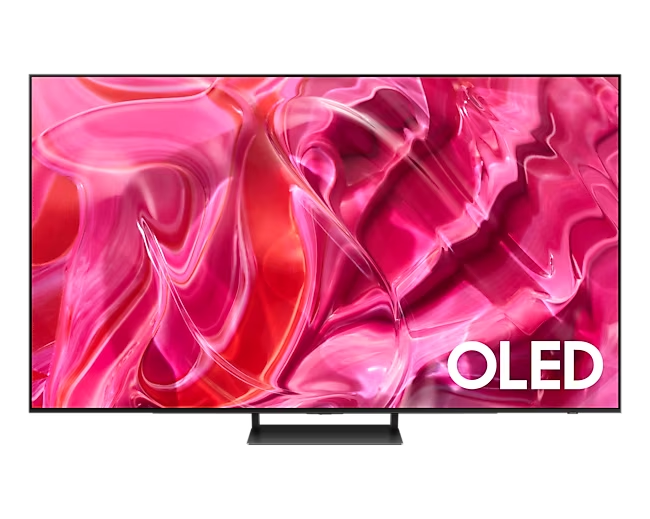
- Television. With the feature of OLED having true black, watching movies like horror movies gives the viewer a great experience. At the same time, due to its flexibility and wide viewing angle, viewers can watch from any position or location with the same quality as watching in front of the screen.
Conclusion
Technological advances create more options for consumers. Thus, understanding the significant differences and the benefits and drawbacks of this technology can give an overview as to which is better and which fits perfectly with your business needs. The choice will always be with the consumers.

