


It was just in the early 2000s when electronic billboards started sprouting out in every major city. Blinding lights from storeys-high LED screens illuminate the skylines of New York, Shanghai, and Tokyo. But more recently, a new “it” display has been taking over building facades: 3D LED billboards.
Remember when Avatar was all the rave in the 2010s when it came out in 3D? Unlike your typical IMAX experience, you won’t need to wear a pair of 3D glasses to make the images pop out of a 3D LED billboard. How do they do this? It’s a combination of playing with perspective and ultra-HD display.
With how seemingly advanced this technology is, you may be wondering if it would cost you an arm and a leg to be able to afford this type of display. While it’s certainly more expensive than a regular flat display, one thing’s for sure: it will draw crowds. And if you’re a start-up wanting to increase brand recognition, it might be a worthy investment. Here’s everything you need to know about 3D LED Billboard prices.
What is a 3D LED Billboard?
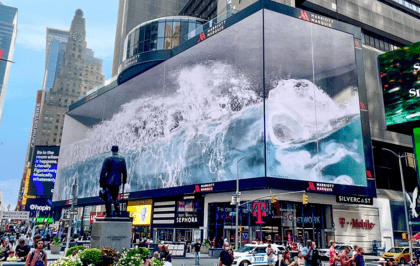
A 3D LED billboard is a type of LED display that creates an optical illusion using the “Naked Eye” technology. This means that the viewers don’t need to wear 3D glasses to feel like the image is coming out of the screen. 3D LED billboards are just your ordinary 2D LED screens that are typically installed wrapping around the corner of a building’s facade to give the illusion of depth.
To achieve the 3D effect, two versions of the same image shot from different angles are merged in a single clip. The merged images are then superimposed to make the viewers’ left and right eyes see different points of view simultaneously, giving the illusion that the content is coming out of the screen.
What 3D LED Billboards Bring to the Table
In a study conducted in Jeddah, Saudi Arabia, 50% of advertising companies said hyper-realistic 3D billboards attract more attention than 2D billboards. Additionally, 40% of the respondents agreed that 3D LED billboards increase sales more than 2D. The combination of strategic location and eye-catching visuals contributes to the success of 3D LED billboards in advertising products and services.
Commercial Value of 3D LED Displays
Advertising
Dynamic content on LED billboards can effectively capture people’s attention because of the unusual sight of images popping out of the screen. In fact, 3D LED billboards are more interesting for viewers than the typical flat 2D screens according to a recent. The one-of-a-kind visual experience enhances people’s memory retention and brand recall, in turn, they associate the image with the brand.
Foot-Traffic
Naked-eye 3D billboards have become tourist attractions in some cities and shopping districts, standing out from their 2D neighbors. Because of this, establishments near and around 3D billboards could see increased foot traffic–potentially translating into sales.
Social Media Footprint
In an age where anything out of the ordinary is almost always going to be shared online, a well-setup 3D billboard could be the next viral post on social media platforms. People are naturally drawn to novelties. And as the culture of reposting and sharing does its work, more and more people will be enticed to visit the location to see it with their very eyes, increasing the content’s viewers and in turn, brand awareness that could turn into commercial success.
What’s Included in the 3D Billboard Price

LED Panels
LED Panels are the basic building blocks of LED displays. An LED display could have multiple LED panels, depending on its size. Each LED panel is made of thousands of pixels, and each pixel is composed of multiple individual light-emitting diodes. The quality of the display is dependent on how many pixels are there across the display. The higher the quality of the materials used in the panel, the higher the cost will be.
Structure
The structure of the LED display is crucial in ensuring its integrity. Larger 3D LED billboards require a more robust frame and structure, adding to the final cost of the display.
Control System
The control system, along with the power supply, is the heart and soul of a 3D LED billboard. A robust control system and an efficient power supply enable the display to function with precision, generating 3D effects with great detail and enhancing the overall viewing experience. However, these will add to the cost of the display.
Installation
The complexity of the installation takes into account the location, skilled personnel, and any specialized equipment needed to mount the 3D LED display. The more complicated the location is, the more manpower is needed, increasing labor-related costs.
Content
As previously mentioned, 3D LED displays use two versions of the same image from different points of view to create the illusion of depth. This would require advanced graphic design and 3D animation. The more complex the content is, the more expensive the final cost could be.
How Much Does A 3D Billboard Cost?
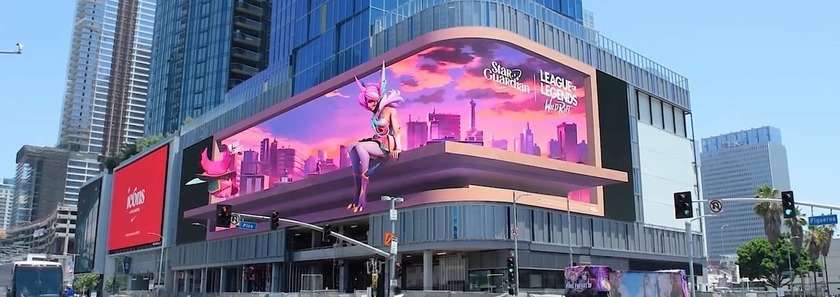
3D LED billboard prices could vary depending on factors like size and display quality. Here’s a breakdown of estimated costs:
- Simpler, Smaller Installations: Smaller installations with standard resolution could range from $10,000 – $50,000.
- Medium-sized and Moderate Complexity: As the size and complexity increase Larger displays with higher resolution could range anywhere between $50,000 and $200,000.
- Large-Scale and High Complexity: Oversized 3D LED billboards in prime locations could go for $200,000 or higher depending on the resolution.
Note that these are just rough estimates. However, these may not be too far off from real-world prices. These numbers only aim to give you an idea of how much to prepare should you think of buying a 3D LED display.
Factors That Affect 3D LED Screen Price
Like the typical flat-screen display, the price of a 3D LED billboard can vary depending on several factors:
Ownership
The price of a 3D LED screen will vary depending on the type of ownership:
Rental
Rental LED billboards are displays that are temporarily installed for a set duration. The beauty of renting 3D LED billboards is that the prices are already inclusive of all expenses related to installation, such as transporting the LED panels to the location, assembly, disassembly, and maintenance. However, the rate will typically be on a per-hour basis, which could range from a low of $2 to a high of $2,000 or about $1,200 to $15,000 per month.
Owned
The price of owned billboards includes the upfront cost for the display itself, which is typically priced per square meter and varies depending on the size, resolution, and pixel pitch. On top of this, you have to factor in electricity and maintenance costs.
Screen Size
Larger screens will need more LED panels, which means more internal components. The more panels are needed, the more expensive the display will be. LED panels may come in standard sizes 500x500mm and 500x1000mm. To put that into perspective, a small square 3D LED display would need around 6 500x500mm panels. If the panel is priced at $800 per square meter, expect to pay around $2,400.
Here’s a rough estimate of how much 3D billboards cost relative to their sizes:
| Size Category | Dimensions | Estimated Monthly Cost (USD) |
| Small | 4×4 feet | $2,000 – $4,000 |
| Medium | 10×20 feet | $10,000 – $30,000 |
| Large | 20×60 feet | $50,000 – $80,000 |
| Extra Large | Custom sizes | $100,000+ |
3D Content
As previously mentioned, 3D LED displays can make content “come alive” by merging two versions of the same image from different perspectives. This makes viewers see two perspectives simultaneously, creating the illusion of depth. The more complex the content is, the more time is spent on developing and polishing it, hence, the higher costs.
Installation
Like any other LED display, the complexity of the installation contributes to the pricing of a 3D LED display. Applications in high-rise buildings may be more expensive than indoor installations as they may require more personnel and equipment.
Conclusion
Contrary to popular belief, 3D LED displays are just 2D displays. The difference all lies in the content. Regular LED displays show images as is, showing height and width. On the other hand, 3D displays add depth to the image by merging two versions of it from two different points of view. This tricks the viewers’ eyes into thinking that the image is coming out of the screen, but in reality, the left and the right eyes see two sides of the same image.
Like 2D LED screens, the price of 3D LED displays will be relative to the size, resolution, and installation. Their upfront costs may be pretty close to each other, but 3D displays have to factor in the complexity of the content to the final pricing.

