


Technological advancement has given us more options, especially in the digital world, like in LED screen displays. Screen displays have been used in different industries and communities to promote advertisements and information. Using screen displays in public places has been an effective communication tool in bringing the information to a wider audience.
We have different types of screen displays to choose from. And comparing wired vs wireless LED displays is one of the things we can do to assess which is more appropriate to use for our business or next projects.
But before doing so, let’s look at how digital signage works. There are three main core components in the system of digital signage.
- CMS (Content Management System) is a software used for displaying content on screens. This is usually used for creating, managing, and scheduling the content to be displayed on the digital signage.
- Media Player is the hardware component that connects the CMS to the screen display. It is responsible for projecting the content from the CMs to the screen display.
- Screen Display is the actual monitor or screen used to display the content. It varied in size depending on where and how it would be used.
Wired vs Wireless LED Display: Definition
 Image Credit: Gemini AI.
Wired LED Display
What is a wired connection? When we talk about a wired connection, it usually refers to the physical connection of the LED screen displays to the PC or laptop. The LED screen and pc or laptop are usually connected with a cable. There are different cables, like DVI, HDMI, or VGA, that could be used depending on the hardware. Also, to be able to manage the content remotely, the media player should be connected to a network, and Ethernet cables are usually used for this.
Wireless LED Display
Using a wireless network such as Bluetooth, cellular networks, or Wi-Fi to connect the CMS and the media player. There is no need for physical cables to display and project the content to the screen display.
Wired vs Wireless LED Display: Functions
Wired LED Display
How does it work? A wired LED display primarily works using cables to connect hardware to the screen displays. This cable enables the transfer of content from the media player to the screen display where it is being projected. Different signal cables can be used for connections, such as CAT5/ CAT6, DVI, or HDMI. These cables usually connect the controller to project the content to the LED screen display.
Also, a power cord is used to connect the system to a power source. This connection provides a more reliable and stable power connection.
Thus, comparing wired vs wireless LED displays, the former has always been dependable, providing a more stable and predictable connection. Using wired LED displays has minimal interference and usually doesn’t experience dropouts and lag.
These types of LED displays are best used for content with fast-moving videos and animations.
Wireless LED Display
On the other hand, this type of LED display does not need signal cables to project an image or videos on the screen. The display has a built-in receiver. Since this does not use any cables, a transmitter is needed to display the contents on the screen.
Wired vs Wireless LED Display: Advantages and Disadvantages
Every technology has its own advantages and disadvantages; now we will look at the different pros and cons of both wired and wireless LED displays to be able to compare these technologies. Thus, comparing this can help us decide which to use.
Wired LED Display
 Image Credit: ChatGPT.
Advantages
- Stable and Reliable. Using a cable connection reduced the risk of interruption and signal loss.
- Cost-efficient. Comparing the cost of cables to the transmitter and receiver of wireless displays, it is known that cables are cheaper.
- Constant power supply. Wire display uses electricity directly from the power source with the use of a cable wire. This makes a continuous power supply to the display.
- Fast data transmission. Comparing wired vs wireless LED displays, the former’s data and contents to be displayed on the screen are delivered continuously in real time. Also, high bandwidth and high resolution can be displayed without delay.
- Security. Having physical cables can make it difficult for hackers and other unauthorized users to change and manipulate the contents to be displayed
Disadvantages
- Installation. Having wired connections means using a lot of cables for its connection. This also means that more time will be utilized to install the LED screen displays, especially for outdoors and larger screens. Also, professionals may be hired for this job.
- Flexibility. Once the screen is placed in a specific place, it is less likely to be transferred to a different space since there is a lot of wiring and work to be done.
- Visual Appearance. Comparing wired vs wireless LED displays, the former uses a lot of wiring to connect the hardware to its LED screen. And due to the wiring connections, if not properly hidden can be unattractive and unpleasant to the eyes. This limitation can specifically be seen for indoor wired screen displays.
- Length. Using very long cables for the display can cause signal problems, especially with its signal. Therefore, a high-grade wiring can be used or a signal booster to increase the signal quality for this setup.
Wireless LED Display

Advantages
- Flexibility. Wireless LED displays have greater flexibility since there is no wiring connected to them. Changing the position or placement of the screen display is much easier.
- Visual Appearance. Comparing wired vs wireless LED displays, the latter is more appealing, cleaner, and more modern to look at since no visible wires are running all around it.
- Convenience. There is no need for installation; therefore, the screen display can just be mounted to the area where you want to place it. It can also be moved conveniently to an area where you want it. Also, remote management can be done using a wireless display.
- Cost Efficiency. Wiring and installation are not needed for wireless display; therefore, there is no wiring or installation cost. Also, maintenance is low-cost.
Disadvantages
- Reliability. Using wireless LED screen displays can face challenges like signal loss. Comparing wired vs wireless LED displays, the latter have an unstable signal and are usually at risk for interference, which could affect the display quality.
- Power Source. This is quite a problem if the installation is in an outdoor environment and the LED screens used are wide. The bigger the LED screen displays the higher the power supply required. Therefore, to provide the needed power, wireless displays often need a backup power source.
- Speed restriction. Due to the bandwidth limitations, higher resolutions may have lower performance.
- Delayed data transmission. Wireless connections may cause some delays and lag while displaying the content on the LED screen.
- Security. Having a wireless network could pose a higher risk for hacking and unauthorized access, and control of the content. Thus, there is a need for encryption for a more secure network.
Wired vs Wireless LED Display: Considerations in Choosing the Right LED Display
There are a lot of things to take into consideration when choosing which to use.
Application and Content
Consider the type of content to be displayed to determine which LED display is best. For stable and fixed content, a wireless connection can be used, but if the content consists of rapidly moving videos and animations, it’s best to use a wired connection.
Budget and Financial Allocation
The allocated budget will determine which to choose. We need to determine the budget for the initial cost of the equipment, materials, installation, and also the budget for its regular maintenance.
Comparing wired vs wireless LED displays, the former have a lower initial cost because of the cables and installation. Thus, wireless can be pricey due to the equipment needed, such as transmitters. Also, maintenance for wireless might be expensive in the long run.
Environment and Site
Before choosing which connection to use, it is important to know where the LED screen display will be installed. For example, in areas where interference is higher, a wired connection is the best option.
For multiple screens used outdoors, it needs to be more stable than flexible; therefore wired connection is used. However, if it requires changing location and sites, such as events and exhibitions, a wireless LED display is better to use.
Security
It is important to take into consideration whether there is sensitive information to be displayed. Therefore, security is a must to prevent hackers and unauthorized users from accessing the content.
The most reliable would be using a wired connection. Although a wireless connection could also be used by keeping the network can be secured through encryption.
Wired vs Wireless LED Display: Summary Table
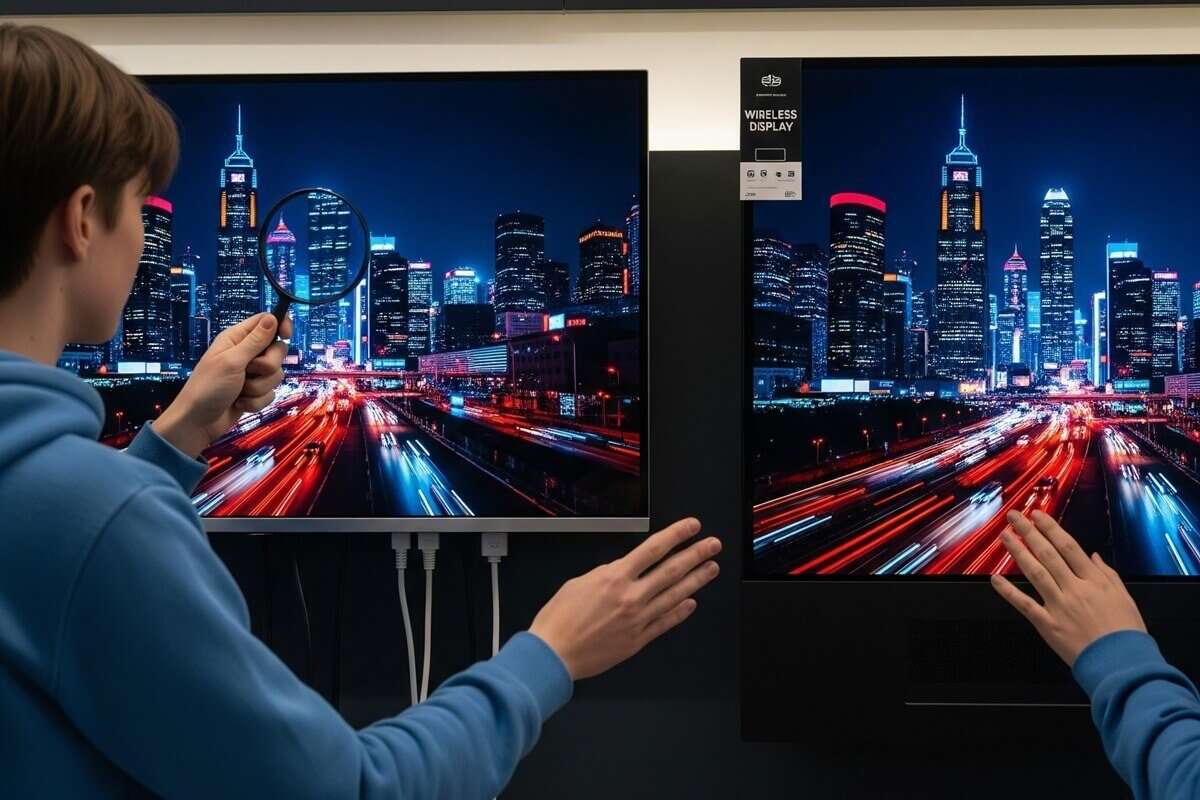 Image Credit: Gemini AI.
Let us summarize and compare to see the differences, benefits, and limitations of both wired and wireless LED displays.
| Feature | Wired LED Display Connection | Wireless LED Display Connection |
| Data transmission | Fast For fast-moving video and animations with high resolution. | Moderate It can affect the display if it’s in high resolution. |
| Flexibility | Limited and restricted. Screen displays cannot be easily transferred to a different location because of the cables and wiring. | Highly flexible. It can be positioned and transferred wherever as long as it’s within the wireless connection range. |
| Lower cost for cable wires and installation | Higher due to additional equipment like transmitters | |
| Speed of Installation | Slow It requires laying out the cable plan | Fast Little time needed to set up. |
| Reliability and stability of the signal | High reliability Low risk for interference and signal loss | Moderate reliability Vulnerable to interference and signal loss depending on the area. |
| Security | High security Less vulnerable to getting hacked. | Moderate to low security Prone to hacking, that’s why it needs additional encryption. |
| Maintenance | Easy and simple to repair cables and troubleshoot connections. | Complicated Requires a skilled person and special equipment to resolve issues |
| Expandability | Can easily add displays. It only requires connecting the existing cables to the new panel. | Require additional hardware to expand the capacity of the network. |
| Visual Appearance | Needs cable management to neatly secure and hide wiring from sight. | Cleaner No cable wiring |
| Power Supply | Directly connected to the power supply. | Needs a separate power supply. |
| Best Use | Fixed and permanent Stable and reliable connection with high security | Temporary Flexible and easy to assemble and dismantle. |
| New Technology | HDBaseT. Longer cable with high bandwidth. | Wi-Fi 6E and 5G. More reliable and faster |
Wired vs Wireless LED Display: Conclusion
Understanding both wired and wireless LED displays will help us choose properly. Comparing the benefits and limitations of each will be of great help. Both have different strengths to offer; therefore, learning which one you need to use will be easier to choose.

