


LED technology has grown by leaps and bounds in the past few years. The first-generation LED displays are almost obsolete, and clearer, brighter, and more energy-efficient models dominate the market. When OLED TVs first came into the picture, it was all the industry’s rage. Today, other LED displays are claiming to be the best, each offering what the other doesn’t have. Mini LED and OLED, however, are the two most notable display technologies.
Leading TV manufacturers have invested in these technologies–particularly, LG on OLED and Samsung on Mini LED display–with great success. But how do they stack up against each other? Which one is better visuals-wise and price-wise?
Introduction to Mini LED and OLED Displays
OLED Displays
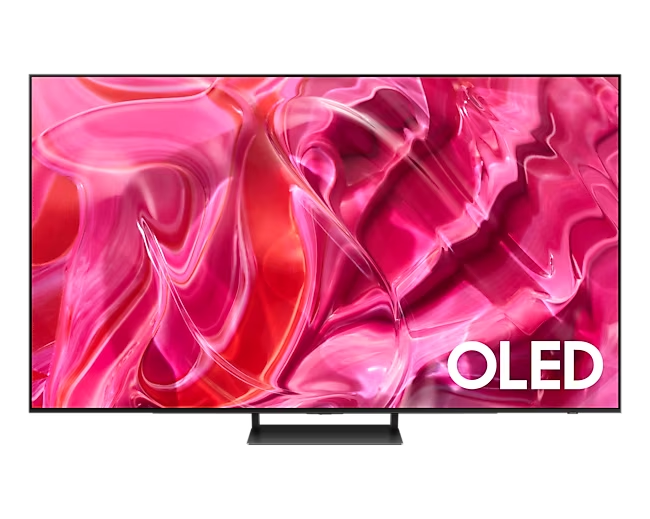
Organic Light Emitting Diode is known by its acronym, OLED. This has to do with the display’s light source. Organic components used in OLEDs emit light when they come into contact with electricity. First launched in 2013, the OLED display was originally intended to be the more refined sibling of the conventional LED. However, further development led to the creation of a new display technology.
The organic material inside OLED pixels produces a brighter light as the amount of electricity increases. This also means they won’t turn on without electricity, which helps in local dimming. Local dimming refers to the precise control of brightness in a specific area on the display, producing brighter whites and deeper blacks (aka contrast ratio).
Because OLED panels do not need a separate backlight, they can be applied directly onto glass, allowing for a flatter, slimmer, and more lightweight display. There are also newer OLED displays that use a quantum dot layer with blue OLEDs to increase brightness.
Mini LED Displays

Like traditional LED displays, mini LED displays use backlight to illuminate the LCD panel. However, the difference lies in the size of the LEDs they use. Typical LED pixels contain three subpixels with red, green, and blue filters. These subpixels are combined in different intensities to produce different colors.
The mini-LED backlight contains thousands of mini LEDs measuring 0.004 to 0.008 inches each. These mini LEDs are one-fifth the size of a regular LED, allowing more to be packed together. Their small size is suitable for local dimming, allowing precise control of where exactly in the display to decrease or increase brightness. Mini LEDs are not as small as those found in micro-LED displays, which are 1/100th the size of an ordinary LED. However, micro LED technology is rather expensive and is not applicable for mass production for practical reasons.
Display Mechanism and Structure

How Mini LED Displays Work
Mini LED technology is essentially the natural progression of LCD technology. Both display types illuminate a liquid crystal layer to create images, differing only in their backlighting source. Standard LCDs use cold cathode fluorescent lamps (CCFLs) horizontally installed behind the display. Meanwhile, mini LED displays use thousands of mini LEDs–smaller than standard LEDS but bigger than micro LEDs–to light up the liquid crystal layer. Their smaller size allows for a more accurate local dimming and greater contrast ratio. The high contrast ratio gives images depth and makes them appear more realistic.
How OLED Displays Work
Unlike CCFLs and LEDs that illuminate a crystal liquid layer, OLEDs emit their own light directly beneath the screen. OLEDs contain carbon-based molecules that light up when electricity is applied. This ability to self-light allows OLEDs to stand as individual pixels, eliminating the need for a liquid crystal layer, and effectively slimming down the display’s build.
Display Quality Comparison
Sharpness and Resolution
A display’s sharpness is directly linked to its resolution. The higher the resolution, the more detailed the images are. Commercial applications such as TVs have a resolution of up to 4K. However, in recent years, competitors Samsung and LG have launched ultra-high definition 8K smart TVs that are changing the home entertainment landscape.
Right now, there is little difference between OLEDs and mini-LEDs in terms of display sharpness and resolutions. Both technologies are capable of up to 4K resolutions, and eventually, 8K.
Verdict: Tie
Color Quality and Viewing Angles

Color gamut or the spectrum of colors a display can produce, is crucial for an accurate recreation of images. TVs nowadays are capable of covering up to 90% of the Rec. 2020 standard. A 100% coverage is yet to be achieved, but Samsung’s QD-OLED display was able to produce 90% of the sRGB spectrum. Meanwhile, mini-LED displays can’t quite cover the same range. However, this has nothing to do with the mini-LEDs’ capabilities but is more about the color filters that manufacturers use.
Color quality significantly affects a display’s viewing angles. Good viewing angles ensure the images’ color and details are not distorted when viewed off-centered. This is crucial as displays are not always viewed from an ideal location, especially when there are multiple viewers.
Mini LEDs have limited viewing angles due to the display type (IPS vs VA) used on top of the backlight. In comparison, OLEDs have wider viewing angles as the pixels emit light in all directions
Verdict: OLED wins
Brightness Levels and Contrast Ratio

OLED displays traditionally lagged in terms of brightness levels, as individual OLEDs can’t produce the same amount of brightness as mini-LED backlighting can. However, manufacturers have found a way to overcome this limitation by using quantum dots to produce pure RGB lights. However, without QD, traditional OLED displays are limited to 1,000 nits. Meanwhile, mini-LED displays can go as bright as 2,000 nits and beyond.
Contrast ratio is the difference between a display’s brightest whites and deepest blacks. This is important in giving depth to images and making them standout from the background. With OLEDs only lighting up upon application of electricity, they will remain shut off without it. This allows OLED displays to produce truer blacks than mini-LED displays.
Verdict: Mini-LED wins
Health and Environmental Impact
Eye Health and Comfort

There’s been a long-standing myth about LCDs’ negative impact on vision. This may related to their low refresh rates (or how often the screen changes images per second), which, in turn, produces flickering that can cause discomfort during extended periods of watching. Studies have shown mini-LED screens emit 7-80% of harmful blue light. Additionally, their excessive glare can strain the eyes and disrupt sleeping patterns by suppressing melatonin secretion.
In comparison, OLED displays emit less than half of mini-LEDs’ blue light emission. They also minimize flickering and glare for a more comfortable viewing experience.
Verdict: OLED wins
Environmental Impact of Mini LED and OLED
Mini-LED’s reliance on backlight significantly affects its environmental impact. Twenty-five percent of the backlight layer is made of plastic. The absence of backlighting in OLED technology limits its plastic usage to just 5% that of mini-LED’s. Additionally, the mini-LED production process takes significantly more time than OLED’s and leaves more carbon footprint.
Verdict: OLED wins
Cost and Availability Comparison
Mini-LED technology predates OLED technology, which is one of the reasons why manufacturers find them easier to produce in larger sizes. Mini-LED production has been polished over the years, making the process faster and cheaper. Mini LED size can be as big as 98 inches while still being under $5,000. Meanwhile, OLED, which is a newer technology, is still being developed and is therefore more expensive than mini-LEDs. While they can be as big as 97 inches, their prize can also go up to $20,000, which is why they aren’t common in commercial applications.
Verdict: Mini-LED wins
Future Developments and Potential Advancements
The OLED display market share is slowly picking up, especially in the smartphone sector. Since the launch of its first Super AMOLED (Active-Matrix OLED) flagship smartphone in 2020, Samsung has continued to improve the technology to lessen screen burn-in and display degradation. Its most recent Galaxy S24 series used Dynamic AMOLED 2X displays that boast up to 2,600 nits brightness and HDR10+ support.

One of OLED’s limitations is its energy efficiency. The organic materials in OLEDs only light up when in contact with electricity. However, not all of this power is used to light up the display. Some is lost in a process that degrades the OLED molecule itself. This causes the bluish tints in LED displays and negatively impacts energy efficiency.
However, researchers are designing a new OLED molecule with protective mechanisms that would prevent energy from damaging the molecule. This would result in more vibrant colors, longer lifespan, cheaper production, and improved energy efficiency.
Mini-LED technology continues to dominate the smart TV market, and will only grow further in the coming years. While not as advanced as the micro LED display technology, its cost-effectiveness is the main reason why manufacturers like Samsung, TCL, and Hisense prefer it over other display technologies. Experts estimate that its global market share will be worth USD 16297.85 million by 2031.
Conclusion: Choosing the Right Display Technology
With all the pros and cons laid down, deciding between the two display types should be a breeze. However, looking at the bigger picture, you’ll realize how both technologies are worth considering. Mini-LED is the runaway winner when it comes to brightness levels and cost-effectiveness. However, OLED is better in terms of viewing angles and comfort.
The choice ultimately boils down to preference. If you want a more affordable display with a higher brightness, go for mini-LEDs. But if you prefer having a wider viewing angle and better contrast ratio, go for OLEDs.

