


LED technology has experienced major progress in recent times due to the development of diverse packaging techniques which improve brightness alongside efficiency and design options. The two main designs for modern LEDs consist of COB (Chip-on-Board) and CSP (Chip Scale Package) LEDs. The two packaging techniques function uniquely because they apply to different operational applications.
People who need lighting solutions must learn how COB and CSP LEDs differ for making suitable choices between residential, commercial, industrial, and automotive applications. You will find complete information about these LED designs that highlights their essential attributes and shows their connection points along with their distinctions to find the right LED solution.
Understanding LED Chip Configurations
What is an LED Chip?
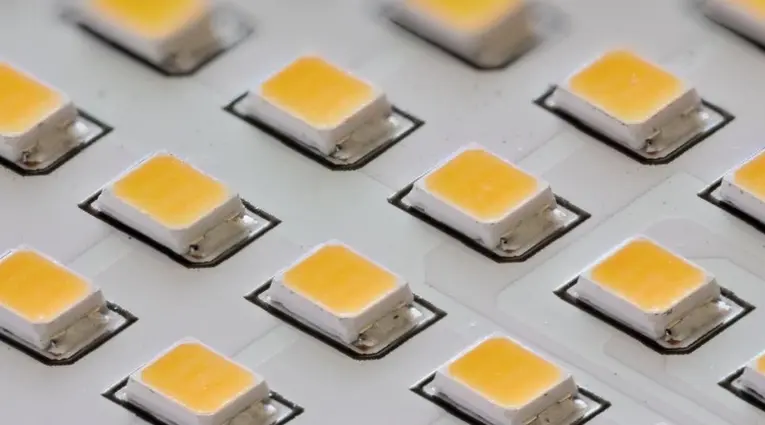
An LED chip serves as the core light-producing section of an LED and consists of semiconductor-based material that uses electrical power to create illumination. All LED lighting systems rely on these chips as their foundation since their specific arrangement establishes overall performance levels and application aptness.
Multiple layers form an LED chip which includes the semiconductor material (gallium nitride), the supporting substrate and electrical connections, as well as sometimes a phosphor coating to modify the output color. The selection of chip configuration leads to changes in these related aspects:
- Different arrangement options influence the amount of visible light released when energy consumption reaches one watt.
- The heat dissipation properties depend on the specific packaging methods used together with the mounting techniques.
- Good configuration techniques lead to longer LED operating times while improving equipment stability.
- Compact designs exist among some configurations that suit applications requiring minimal space availability.
Overview of Standard LED Packaging Techniques
LED chip packaging methods now exist to deliver better light production, enhanced heat control, and greater design adaptability. Various packaging methods used for standard operations include:
SMD (Surface-Mounted Device) LEDs

The industry uses SMD LEDs as one of the first and most popular LED packaging techniques. The PCB (Printed Circuit Board) accepts soldered individual chips which form the structure of these LEDs. They offer:
- They supply efficient operation despite offering lesser performance than contemporary packages by maintaining sensible prices.
- Common in residential, automotive, and decorative lighting.
- SMD LEDs contain specific drawbacks which include separated diodes that create visible dots requiring extra diffusers for generating smooth illumination.
The arrays of individual diodes in SMD LEDs generate visible “dot effects” which need additional diffusers to achieve uniform lighting effects.
COB (Chip-on-Board) LEDs

COB LEDs utilize single-substrate integration to unite numerous LED chips, resulting in the creation of a strong light-emitting source. The integration of multiple LED chips onto a single substrate through this method reduces the requirement for individual casings, thus achieving these advantages:
- Small areas containing multiple chips yield superior levels of brightness because of higher light density.
- Such method eliminates hot spots and makes possible a continuous lighting beam through improved uniformity.
- Improved thermal management occurs because COB LEDs have expanded heat dissipation surface area.
High-power street lighting fixtures, floodlights, and automotive headlights benefit the most from COB LEDs.
CSP (Chip Scale Package) LEDs

CSP LEDs represent an innovative LED packaging approach through which manufacturers can reduce LED chips by dispensing with standard packaging components. Key features include:
- The small dimensions of this package enable effective use in mobile devices and micro-LED technologies.
- The direct connection between LED chips and PCB enhances both their heat dispersion and their operating efficiency.
- Less packaging layers decrease the preliminary cost of production.
The layout flexibility of CSP LEDs surpasses COB LEDs since these devices do not need external circuit boards or reflectors to function properly.
The Importance of Choosing the Right Configuration
Evaluating the correct combination of LED chips depends on the purpose of the intended lighting system. The COB LED has greater brightness capabilities but CSP LEDs provide improved size and enhanced energy efficiency characteristics. Identification of lighting application needs allows users to achieve their best performance results in industrial flooding situations or small electronic screen illumination purposes.
What is COB LED Technology?

Definition & Structure
The packaging technology of the COB (Chip-on-Board) LED system involves mounting various LED chips directly onto shared substrates that do not use separate housings for each diode. White lighting emerges from applying phosphor on top of the chips to create uniform coloration.
The combination of properly designed heat sinks with COB LEDs enables very efficient operation, producing bright uniform emission from these devices, while emitting minimal waste heat.
Characteristics of COB LEDs
COB LEDs are suitable for bright illumination systems which need uniform lighting due to several key characteristics:
- High-density LED chips that are closely spaced enable a powerful light intensity.
- COB LEDs offer uniform illumination because they remove the distinctive spot pattern found in SMD LEDs while producing perfect ray distributions.
- COB LEDs demand heat sinks because their high power specifications require specific thermal regulation solutions.
- Complex system manufacturing for LED devices leads to moderately elevated overall prices than basic LED arrangements.
Common Applications of COB LEDs
The application field of COB LEDs includes various situations that need intense and uniform lighting solutions.
- General Lighting: Downlights, floodlights, streetlights, and high-bay lighting.
- Automotive Lighting: Headlights, auxiliary lighting, and off-road lamps.
- Industrial & Commercial Use: Warehouses, factories, and large retail spaces.
- Stage & Studio Lighting: High-output spotlights and floodlights for film production and concerts.
What is CSP LED Technology?

Definition & Structure
The CSP (Chip Scale Package) LED technology goes beyond conventional LED packaging by directly mounting chips to PCBs. The LED chip receives direct installation on the PCB since it omits wire bonding and encapsulation layers.
The CSP LED design approach produces minimalistic components, leading to reduced size, better efficiency, and cost-effectiveness suitable for dense LED applications.
Characteristics of CSP LEDs
The primary distinct characteristics that define CSP LEDs consist of:
- The ultra-compact dimension cuts away excessive packaging space, thus decreasing total size.
- Thermally efficient and efficient light-emitting operations arise from direct PCB connections.
- Allows for thinner, more versatile lighting solutions.
- The manufacturing process of CSP LEDs remains cost-efficient because it requires exact circuit controls.
Common Applications of CSP LEDs
The application of CSP LEDs works best in situations that need small, precise illumination assignments:
- The display technology in smartphones is combined with tablet technologies and TV backlight systems in consumer electronics.
- CSP LEDs find applications in the automotive industry through their use in adaptive headlights, taillights, and dashboard illumination systems.
- The lighting solutions include both LED strips and dynamic architectural systems for accent purposes.
- Compact spaces need efficient and small LEDs which High-Density LED Arrays provide.
Key Similarities Between COB and CSP LEDs
The leading features of COB and CSP LEDs combine to provide modern lighting technology with their advanced solutions despite their different operational properties. The two devices share essential features including their space-efficient structure, optimal efficiency, and better temperature management capabilities. Knowing these common features enables a better assessment of how these LEDs surpass standard allowed LED setup formats.
Direct LED Chip Mounting
Direct LED chip mounting occurs in both COB and CSP LEDs, which explains why these designs require fewer packaging components. The method enhances light efficiency since it eliminates waste that emerges from standard LED packaging processes.
- The COB LED technology places different LED chips directly onto one shared platform, which creates a unified bright light source.
- Through CSP LED technology, manufacturers embed the LED chip onto PCB (Printed Circuit Board) surfaces, simplifying overall assembly complexity.
Both COB and CSP LEDs benefit from direct mounting since it enhances thermal conductivity, enabling superior heat management than standard LED packaging techniques.
Compact Form Factor
These technologies present smaller designs than the conventional SMD (Surface-Mounted Device) LED units. The absence of distinct LED packages helps to minimize the space required by the lighting system.
- COB LEDs arrange a large number of LED chips inside one unified unit to decrease the total amount of solder junctions and connection points.
- The CSP LED design removes the need for individual casings, which achieves minimum size and thickness for lighting systems.
These compact devices find their most suitable applications in mobile displays, automotive lighting applications, and high-density LED arrays because of their restricted dimensions.
High Lumen Output
The design of COB and CSP LEDs achieves obvious characteristics of maximum light output with minimum energy consumption. These LEDs prove more efficient than conventional LED designs since they combine optimized placement and better heat management technologies.
- The placement of multiple LED chips close within COB LEDs allows them to produce dense light output that creates an even and intense illumination.
- CSP LEDs perform well at maintaining high lumen output by ensuring maximum efficiency within each LED chip, making them compact yet powerful lighting solutions.
The capabilities of these LED types prove beneficial when applied to various high-performance lighting situations across industrial, commercial, and automotive sectors.
Heat Dissipation Efficiency
The ability to dissipate heat efficiently stands as a fundamental performance factor for LED technology where COB and CSP LEDs demonstrate exceptional competency.
- Due to their bigger substrate size, COB LEDs transfer heat better yet need external heat sinks to reach maximum thermal performance.
- Both CSP LEDs achieve better thermal performance because they integrate the chip directly onto the PCB, resulting in faster heat dissipation by eliminating multiple thermal resistance elements.
Both LED technologies surpass SMD LEDs when it comes to heat management, thus extending product lifespans and delivering controlled operation stability particularly when powering high-performance applications.
Versatility in Application
COB and CSP LED devices serve various lighting applications because they maintain versatility in different industrial needs.
- The widespread use of COB LEDs covers many applications, which need broad and even illumination, such as floodlight systems, downlight fixtures, and high-bay installations.
- Companies use CSP LEDs to power screens in portable devices while also using them for adaptive car lights along with flexible LED strips.
Differences Between COB and CSP LEDs
COB LEDs share some basic features with CSP LEDs yet display substantial dissimilarities throughout their structural elements, operational standards, economical rates, and practical applications. The unique characteristics of each LED type determine how they will be applied in different industrial sectors. The following discussion explains significant differences which define how COB and CSP LEDs operate along with their performance boundaries.
Configuration and Structure
The structural design of COB and CSP LEDs plays a crucial role in their performance and application.
| Feature | COB LED | CSP LED |
| Packaging | The design features multiple LED chips installed directly onto one substrate surface, which receives a phosphor coating | The PCB receives LED chips directly without any kind of packaging material |
| Size | The integrated multiple chips produce bigger packaging dimensions | These LEDs feature an extremely small size, which helps reduce their entire physical space needed |
| Chip Arrangement | A single module results from a close arrangement of numerous LED dies | Single-chip configuration enables tight installations of many LED devices at once |
| Encapsulation | The light source needs encapsulation because it enhances uniformity in the emission of light | The product does not need extra phosphor coatings, which results in reduced device thickness |
- The manufacturing process for COB LEDs creates a single light source by grouping numerous LED chips densely. High brightness and uniformity requirements call for COB LEDs in specific applications because of their advantageous properties.
- Through its elimination of typical LED packaging, CSP LEDs create designs which are extremely compact and versatile.
Light Output & Efficiency
The selection between COB and CSP LEDs depends on their performance in delivering light output and their operational efficiency.
| Feature | COB LED | CSP LED |
| Luminous Efficiency | CSP LED generates strong brightness through the joint operation of multiple chips | The lighting efficiency reaches extremely high levels due to individual independent chip operations |
| Light Uniformity | The technology produces excellent light output because it removes hot spot visibility while generating uniform light distribution | The operative performance can be enhanced through optical diffusers to achieve uniformity |
| Beam Angle | These LEDs operate within 120 to 180 degrees beam angles which makes them suitable for extensive lighting scenarios | More directional, requiring lenses for wider coverage |
| Color Consistency | Consistent across the entire light-emitting surface | Additional technologies may be necessary outside the LED for achieving color uniformity in the output result |
- COB LEDs deliver outstanding performance for applications that require widespread uniform lighting distribution.
- CSP LEDs are highly efficient light sources, which provide directional control, making them suitable for applications that need precise beam control.
Thermal Management
How LEDs dissipate heat determines their operational span and working capacity. Proper thermal management systems protect LED devices from deterioration through overheating.
| Feature | COB LED | CSP LED |
| Heat Dissipation | The device needs external heat sinks for efficient cooling operations to work | This design enhances efficiency because the LEDs directly mount to the PCB and need fewer barriers to conduct heat |
| Thermal Resistance | Higher due to multiple chips generating heat close to one another | Lower due to minimal layers between the chip and PCB |
| Cooling Requirements | Needs additional cooling mechanisms like aluminum substrates or active cooling fans | The cooling system integrates internally, which eliminates the requirement for other competing components |
- A thermal management system must be efficient for COB LEDs to manage the heat from multiple LED dies.
- CSP LEDs provide expert heat dissipation performance because they link directly to the PCB board which automatically lowers thermal resistance levels.
Cost & Manufacturing Complexity
Market demand, along with affordability of COB and CSP LEDs, is directly influenced by their production expenses and manufacturing system intricacy.
| Feature | COB LED | CSP LED |
| Production Cost | Higher due to complex chip assembly and encapsulation | The packaging-free construction leads to lower production costs |
| Component Complexity | Multiple components must be included (substrates, phosphor layers, and heat sinks | Their basic structure makes them more affordable compared to other versions |
| Manufacturing Process | The process of assembly and thermal management requires more steps | The manufacturing procedure requires less time and lower costs due to its streamlined nature |
| Repair & Replacement | The incorporation of integrated LED chips makes the replacement process more challenging | The modular design concepts benefit from these components because of their easy replacability and integration quality |
- Due to its complicated production requirements and increased material needs, the total manufacturing costs for COB LEDs become higher.
- The reduced number of needed components along with a basic structure makes CSP LEDs affordable to manufacture.
Design Flexibility
The opportunity to design LEDs for specific lighting uses makes selection of the right technology essential.
| Feature | COB LED | CSP LED |
| Size Customization | Limited due to fixed multi-chip configuration | Highly adaptable to different sizes and shapes |
| Application Flexibility | Best for large-area lighting applications | Best for miniaturized and precision lighting |
| Integration with Optical Lenses | They provide capability for integration with secondary optics used for beam shaping purposes | Need additional lenses to enhance the distribution of light output |
| Suitability for Flexible PCBs | Not ideal due to rigid substrate requirements | The product suits all types of flexible LED strip installations perfectly |
- The COB LED design excels at high-power extended lighting needs.
- The flexibly designed CSP LED technology proves perfect for producing compact high-density applications in adaptive automotive lighting and wearable devices.
Summary of Key Differences
To summarize, COB and CSP LEDs cater to different lighting needs based on their distinct properties:
| Feature | Best Choice |
| Best for High Brightness & Uniformity | COB LED |
| Best for Compact, Lightweight Designs | CSP LED |
| Best Thermal Performance | CSP LED |
| Best for Large-Area Illumination | COB LED |
| Best Cost-Efficiency | CSP LED |
| Best for Flexible Applications | CSP LED |
Choosing Between COB and CSP LEDs
The selection of proper LED technology rests on analyzing multiple variables including usage, power efficiency, brightness levels, and budget requirements. The lighting needs of different applications require either COB (Chip-on-Board) LEDs or CSP (Chip Scale Package) LEDs which demonstrate distinct advantages. The following section presents suitable cases for selecting each type with an evaluation of their core advantages and limitations.
When to Choose COB LEDs
COB LEDs remain as the top selection when high-intensity and uniform lighting across extended areas are required. The multi-chip design enables them to deliver strong illumination suitable for these applications:
- Strong consistent brightness constitutes a core advantage of COB LEDs for high-output lighting systems.
- Industrial and commercial environments use COB LEDs to provide illumination for warehouses, factories, retail stores, and large indoor areas, demanding whole space visibility.
- These fixtures benefit streetlights, floodlights, and security lighting because they provide both high efficiency and efficiency.
- The lighting technology used in motor vehicle headlights and fog lights makes automotive applications possible thanks to COB LEDs, which enhances driver visibility.
- Stage and studio lighting applications benefit from COB LEDs because their consistent output quality provides perfect coverage for film studios and theaters and photography equipment.
- The intense shadow-free illumination of COB LEDs makes them specifically useful for medical tools and precise lighting equipment.
- Downlights and recessed lighting provide residential and office spaces with smooth diffused illumination which contains no visible LED dots.
When to Choose CSP LEDs
Customers should choose CSP LEDs because these LEDs offer the most beneficial combination of compact size and high efficiency combined with flexible design options. These LEDs succeed because they are compact and feature superior thermal performance, thus being appropriate in:
- CSP LEDs power electronic displays and smartphones because their tiny size suits mobile devices while delivering maximum efficiency.
- The small size of automotive adaptive lighting systems enables them to implement dynamic headlight technologies for improved road condition adjustment.
- Architectural and accent lighting applications benefit from LED strips and decorative fixtures which require this illumination method.
- Wearable technology systems benefit from CSP LEDs since their miniature size allows them to power smartwatches, fitness trackers, and medical wearable devices.
- Signs and display systems utilize CSP LEDs because their tiny pixels provide outstanding detail in every pixel.
- The thin flexible characteristics of CSP LEDs make them suitable for future lighting designs that require space efficiency in innovative applications.
Strengths & Weaknesses Summary
The certain application requirements determine which LED type should be used because each device type excels in particular circumstances.
| Feature | COB LED | CSP LED |
| Best for High Brightness & Uniformity | ✅ | ❌ |
| Most Compact & Space-Saving | ❌ | ✅ |
| Superior Thermal Management | ❌ | ✅ |
| Best for Large-Area Lighting | ✅ | ❌ |
| Energy Efficiency | ✅ | ✅ |
| Best for Cost-Efficiency in Mass Production | ❌ | ✅ |
| Best for Automotive Headlights | ✅ | ✅ |
| Best for Wearable Devices & Miniaturized Applications | ❌ | ✅ |
| Best for Flexible PCBs & LED Strips | ❌ | ✅ |
Key Considerations When Choosing Between COB and CSP LEDs
The selection between COB LEDs and CSP LEDs depends on these evaluation points:
- COB LEDs produce superior performance under scenarios that demand very high levels of brightness with uniform illumination.
- Applications requiring tight spaces should use CSP LEDs because of their compact size.
- The heat management of CSP LEDs allows better temperature dissipation, lowering the risk of overheating in small electronic devices.
- The production costs of CSP LEDs remain lower than competitive options, thus leading to reduced expenses for large-scale manufacturing.
- COB LEDs work effectively for lighting the industrial segment, general space, and outdoor areas but CSP LEDs suit portable devices and displays most efficiently.
Final Thoughts
The decision between COB and CSP LEDs should be based on unique project needs because they deliver different advantages. The illumination requirements of different settings determine whether COB LEDs match their needs for high brightness alongside broad illumination and uniform light distribution or if CSP LEDs should be used for their compact design and flexibility and superior thermal performance.
COB LEDs should be selected for powerful high-intensity applications needed to illuminate large spaces such as street lights, industrial buildings, and vehicle headlights. A multi-chip design of their production enables both maximum lumen output and fully uniform illumination, making them perfect for spaces needing bright and constant light distribution. LED chips clustered together demand supplementary heat sink equipment because of inevitable temperature generation from reduced spacing between LED chips.
CSP LEDs offer the best solution when your goals involve miniaturization requirements, efficiency, and flexibility needs. The technology finds wide application in smartphone components, adaptive automotive lighting systems, and wearable technology because these fields need space-saving solutions with high efficiency. Thermal dissipation in CSP LEDs remains superior, eliminating the need for external cooling solutions, thus making them optimal for small high-performance devices.
The lighting field benefits from COB and CSP LEDs as they represent state-of-the-art solutions which match various requirements. High-power broad-coverage needs require COB LEDs yet CSP LEDs deliver compact high-efficiency designs to the market. Your lighting needs evaluation will enable you to pick the best LED technology that optimizes performance, energy efficiency, and system longevity for your particular application.

